
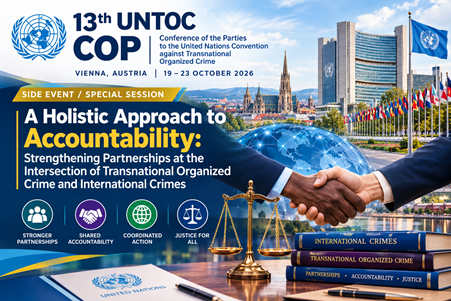
Juritrust Centre was among over 750 NGOs that attended the 13TH UNTOC -COP – 19-23 OCTOBER 2026 – VIENNA AUSTRIA. Apart from the Plenaries whether state officials hammered out details of substantive Conventions or amendments to existing one the meeting featured a variety of side meetings that provided a forum of exchanging knowledge or practice in relevant areas of UNTOC. We bring you a short account of the Panel Discussion on a Holistic Approach to Accountability: Strengthening Partnerships at the Intersection of Transnational Organized Crime and International Crimes which held on 19th October 2026
With more than 14 side events to choose from, the session on strengthening partnerships at the intersection of transnational organised crime and international crimes was irresistible. Attendance was modest, as expected, with most delegates still refining discussions on issues to be resolved in plenary. The session was jointly convened by the ICC-OTP and Eurojust, a private organisation that often facilitates investigations and prosecutions of transnational organised crimes (TOCs). Panellists outlined the partnership’s benefits and its alignment with the OTP’s revised approach to complementarity, which favours greater engagement with situation countries and other countries where preliminary investigations are planned or underway. The central argument was clear: most TOCs have the characteristics of international crimes, such as human trafficking, slavery and kidnapping, and their seriousness is not diminished by being committed largely by non-state actors. Domestic investigations and prosecutions could benefit from intelligence and evidence gathered by ICC investigators, and vice versa. Although panellists shared success stories and highlighted promising prospects for cooperation, several grey areas remained. Would situation states, or states already helping the ICC prosecutor gather evidence, object to that evidence or intelligence being shared with third states? Cooperation with the ICC does not itself open the door to mutual legal assistance (MLA) with another state. What about witnesses who fear reprisals when testifying in national courts but feel more comfortable doing so in The Hague? Finally, could focusing on cases and related evidence for transfer to national authorities distract the ICC from its core objective of punishing those most responsible for the gravest crimes affecting humanity?