
Abuja, Nigeria | Thursday, 12 November 2026
A. PREAMBLE
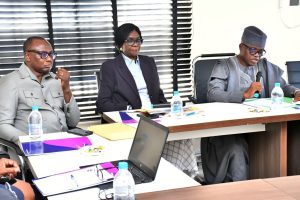
Juritrust Centre for Socio-Legal Research and Documentation Ltd/Gte convened a stakeholder roundtable on “Following the Money: Election Financing, Corruption and Democratic Accountability in Africa” on Thursday, 12 November 2026, at its Secretariat, No. 18 Bashir Y. Ibrahim Street, off 69 Road, Gwarinpa, Abuja.
The roundtable examined the influence of money on electoral processes, the relationship between political financing and corruption, and the effectiveness of existing legal and institutional mechanisms for ensuring transparency and accountability in Nigeria’s electoral system, with particular attention to the 2027 general elections.
The roundtable was opened by the Chief Executive Officer of Juritrust Centre, Prof. Adedeji Adekunle, SAN, and moderated by Prof. Desiree Ameze Guobadia, FNIALS. Presentations were delivered by Hon. Benjamin Okezie Kalu, Deputy Speaker of the House of Representatives (represented by Hon. Air Vice Marshal Ojuawo, Member, House Committee on Electoral Matters); Ms. Benigna Ejimba Alaku, Programme Officer of International IDEA; and Prof. Victor Adetula, Professor of International Relations & Development Studies, University of Jos. These were followed by an interactive session.
B. PARTICIPANTS
The roundtable brought together representatives of the National Assembly, academia, international and development organisations, civil society organisations, and other stakeholders in the electoral process. These include: International Institute for Democracy and Electoral Assistance, Konrad Adenauer Stiftung, Nigerian Institute of Advanced Legal Studies (NIALS), Kimpact Development Initiative (KDI), and Centre for Fiscal Transparency and Public Integrity (CEFTPI).
C. OBSERVATIONS
After deliberations, participants noted that:
- Money is necessary for party organisation and electoral participation, but illicit wealth, fraudulent transactions, money laundering, and the use of emerging channels such as virtual assets allow questionable funds to enter politics, distort political equality, and expose elected officials to undue influence.
- The Electoral Act 2026, particularly sections 89 to 94, contains important safeguards on foreign funding, annual financial reporting, contribution limits, campaign expenditure ceilings, post-election returns, and donor disclosure. However, the existence of these provisions does not by itself guarantee compliance; enforcement remains the central challenge.
- Regulatory inaction weakens deterrence. Participants cited the 2023 elections, in which only two political parties were reported to have uploaded their financial statements, with no query or sanction by the Independent National Electoral Commission (INEC) against defaulting parties.
- Campaign spending conducted through third parties, support groups, intermediaries, in-kind contributions, consultants, and digital advertising is difficult to trace, and the ₦100 million threshold for recording donor details under section 94(2) merits policy reconsideration.
- Vote buying and vote selling are two sides of the same problem, and any response must address both the conduct of political actors and the conditions that make voters susceptible to inducement.
- Transparency must extend beyond the sources of political funds to how funds are spent, including whether expenditure is properly documented, disclosed, and lawful.
- While sections 83, 90, 91, 93, and 94 of the Electoral Act 2026 empower INEC to examine party financial records, demand donor and source-of-funds information, and audit election returns, INEC lacks the specialised financial intelligence and investigative capacity to effectively monitor the flow of funds by politicians. Participants observed that the Nigerian Financial Intelligence Unit (NFIU) is far better equipped to track financial flows and suspicious transactions, which would allow INEC to focus on its primary tasks of election administration and management.
- Campaign finance monitoring is not the exclusive responsibility of regulators. Civil society organisations (CSOs) cannot assume statutory enforcement powers, but they can document gaps, publish evidence-based findings, engage authorities, demand explanations, follow up on referrals, pursue public interest litigation where appropriate, and sustain public advocacy.
- Experiences across Africa show that passing a law differs from implementing it, and that transparency without verification leaves political influence unchecked, while enforcement without fairness risks excluding legitimate political participants.
D. RESOLUTIONS AND RECOMMENDATIONS
Arising from the foregoing, the roundtable resolved and recommended as follows:
- The Independent National Electoral Commission (INEC) should:
a. strengthen its capacity for proactive monitoring of campaign contributions and expenditure, rather than relying solely on post-election returns;
b. publish usable, searchable financial data, verify submissions, and act promptly on credible referrals;
c. enforce the Electoral Act impartially, consistently, and credibly, so that violations attract legal consequences irrespective of the political status of those involved; and
d. work with the National Assembly and relevant financial intelligence agencies to realign campaign finance oversight, enabling specialised financial tracking functions to be vested in better-equipped institutions like the NFIU while INEC concentrates on its primary electoral administration mandate. - The National Assembly should:
a. exercise constructive, evidence-based oversight of INEC’s monitoring of campaign finance compliance and the effectiveness of sanctions;
b. review identified gaps in the legal framework, including the donor-identification threshold, the regulation of third-party, in-kind, and digital campaign spending, and the statutory division of labour between INEC and the NFIU in tracking political financial flows; and
c. ensure adequate funding for independent scrutiny, including investigators, auditors, and legal capacity. - Political parties and candidates should adopt transparent digital financial reporting systems, keep proper records of contributions and expenditure, meet all disclosure obligations, and refrain from vote buying and the concealment of spending through informal structures.
- The NFIU and other anti-corruption agencies should take a more active role in tracking political financial flows and strengthen collaboration with INEC to detect, investigate, and address suspicious political financial transactions, within their legal mandates and established information-sharing frameworks.
- Civil society organisations should:
a. build coalitions and adopt a shared, standardised monitoring method rather than working in isolation;
b. shift from a narrow focus on pre- and post-election petitions to sustained, data-driven follow-up on political finance, using targeted sampling and systematic data gathering;
c. apply the six-step watchdog method of observing, recording, estimating, comparing, verifying, and referring, and observe the safeguards of evidence, accuracy, fairness, safety, privacy, and independence; and
d. seek access to political party records and audited accounts as a means of deepening civic participation. - The media should investigate and report evidence responsibly, explain findings to the public, and follow up on referrals and regulatory responses.
- Citizens should observe and document irregularities, ask who organised an activity, who paid for it, and where it was disclosed, and reject vote selling.
E. COMMITMENT AND WAY FORWARD
Participants agreed that the discussions must move beyond this roundtable and that following the money is a shared responsibility of government institutions, civil society, the media, and citizens.
Participants committed to making advocacy on election financing data-driven and knowledge-based in the run-up to the 2027 general elections.
F. APPRECIATION
Participants expressed appreciation to the Juritrust Centre for Socio-Legal Research and Documentation for convening the roundtable, and to the moderator, the presenters, and all participants for their valuable contributions.

Issued in Abuja, Nigeria, this 12th day of November 2026.